Posts

Green Promise Seen in Switch to LED Lighting

Image
"..fast-growing trend that is redefining the century-old conception of lighting, replacing energy-wasting disposable bulbs with efficient fixtures that are often semi-permanent, like those used in plumbing. Studies suggest that a complete conversion to the lights could decrease carbon dioxide emissions from electric power use for lighting by up to 50 percent in just over 20 years; in the United States, lighting accounts for about 6 percent of all energy use. A recent report by McKinsey & Company cited conversion to LED lighting as potentially the most cost effective of a number of simple approaches to tackling global warming using existing technology." Read more...

Report: Carbon pollution to grow by 40 percent

Image
WASHINGTON - The amount of heat-trapping carbon dioxide seeping into the atmosphere will increase by nearly 40 percent worldwide by 2030 if ways are not found to require mandatory emission reductions, a U.S. government report said Wednesday. The Energy Information Administration said world energy consumption is expected to grow by 44 percent over the next two decades as the global economy recovers and continues to expand. The biggest increases in energy use will come from economically developing countries such as China and India. Read more...

Major Greenhouse Emitters and Solar Energy

Obama in Health Insurance Industry Hip Pocket

Image
by Mike O'Brien If I were to discontinue my TV cable, one show that I would miss would be Bill Moyers. He consistently hosts a program with thought provoking guests on a wide variety of current topics and often their voices are drowned out by the corporate media. This past week was one such time. "....It's a Harris poll last fall. One out of 14 people think that the health insurance industry is honest and trustworthy. On the other hand, in Washington, they're in bed with the health insurance industry. Just as Wall Street and the banks have bought the Congress to get what they want in terms of the bailout, the health insurance industry has bought and influenced members of Congress and the President so much that they don't even consider the possibility of a plan that doesn't have a health insurance industry..." The topic was concerning a single payer healthcare system and hosted the following guests: Dr. David Himmelstein Dr. David Himmelstein is associate...

A Cautionary Video About America’s ‘Stuff’

Image
The thick-lined drawings of the Earth, a factory and a house, meant to convey the cycle of human consumption, are straightforward and child-friendly. So are the pictures of dark puffs of factory smoke and an outlined skull and crossbones, representing polluting chemicals floating in the air.Which is one reason “The Story of Stuff,” a 20-minute video about the effects of human consumption, has become a sleeper hit in classrooms across the nation. The video is a cheerful but brutal assessment of how much Americans waste, and it has its detractors. But it has been embraced by teachers eager to supplement textbooks that lag behind scientific findings on climate change and pollution. And many children who watch it take it to heart: riding in the car one day with his parents in Tacoma, Wash., Rafael de la Torre Batker, 9, was worried about whether it would be bad for the planet if he got a new set of Legos. Read more and view video ..

Don't Worry, Be Happy

Image
What attracted me to Transition, as the movement is called, was the word resilience, with its implications of being skilled, being ready, being confident, and therefore being optimistic about The Day After Tomorrow. The word is all over Transition’s literature, all over its YouTube clips. It seemed such a superior word to green and sustainable and eco—once hot, now almost clichés, and subject to corruption by the market. But resilience, you can’t fake. A resilient person is who I want to be. And if I’m not inherently resilient, can I learn to be? Read More.....

Guerilla Gardening: Eating The Suburbs

Image
I can not think a better article to represent this blog........Mike The Age recently had an article on the emerging practice of "guerilla gardening", taking a look at the "Gardening guerillas in our midst". This concept seems to have steadily increased in popularity in recent years (admittedly from a very low base) as the permaculture movement's ideas have been propagated through the community. Unlike the usual approach taken when trying to grow food in the suburbs - converting spare land on your own property (as discussed by aeldric previously and, more recently, in Jeff Vail's series on A Resilient Suburbia) - guerilla gardening involves cultivating any spare patch of urban land that isn't being used for another purpose, which could provide a substantial addition to the food growing potential of suburbia Read More

Transportation Renaissance Won't Happen With Detroit Bailout

This morning I begin my Sunday morning like most other mornings by reading the New York Times and scanning the news. Today I read about the worsening US auto industry illustrated by a dealer in Quincy Florida and his struggle to stay open.Bruce Thomas has spent his life working and building his dealership to the point where he is the second largest employer in his hometown and where he has over the years support numerous charitable organizations. The future looks bleak for Bruce, the mayor of Quincy is worried about the impact of Bruce going out of business and people are scratching their heads wondering what happened. For those of us who have been unhappy with the Big 3 since the oil embargo of the 70's (yes I am that old!), this downturn is hardly unexpected. It reminds me of the phrase "what do you do when you are climbing the ladder of success only to find out you are on the wrong wall?" This is where we find ourselves, and I have to admit that we told you so. So...

Climate Confusion: Who Wins?

Image
by Michael O'Brien Climate change is the biggest challenge we face as a humans. Any serious student who analyses the information recognizes that the overwhelming consensus from scientists is that we have a very small period of time in which our efforts will have a positive impact for our planet and our children's future. For the past 10 years or so, there has been rigorous debate both by the scientific community and in the press about climate change. The debate is over, the issues have been discussed and now is the time for us to take responsibility for our future. It is fascinating to watch the media feel the need to present the “other side” of this issue when there is discourse about climate change. My guess is that they feel vulnerable from the vocal skeptics or right wing talk show hosts so they include a dwindling number of scientists or spokespeople who argue against human causation. It seems there is an inordinate amount of air time devoted to this topic in proportion...

Our Automobile Future

Image
2008-Jan-18 by Michael O'Brien Our Automobile Future I write this letter as we come off the heels of the Bali Conference where world leaders met to discuss the issue of climate change. This important meeting did result in an agreement that has been described by Thomas Friedman as “incremental” change. Rajendra Pachauri, head of the prestigious United Nations Intergovernmental Panel on Climate Change reported that “If there's no action before 2012, that's too late. What we do in the next two to three years will determine our future. This is the defining moment." Friedman discusses in his opinion in a New York Times op-ed article that the change we need has to be transformational. A little tweaking here and a little tweaking there is not going to protect ourselves from the predictable calamity that scientists say will occur. A case in point is automobile usage worldwide. According to Elizabeth Kobert who wrote a article titled “Running on Fumes” for the New Yorker, she s...

Why the era of cheap food is over

Image
Christian Science Monitor Food prices worldwide hit record highs in 2006, and all the signs are that they will go on rising this year, and for the foreseeable future. The era of cheap food, the experts say, is over and we are going to have to get used to it. This is easier said than done for millions around the world, as evidenced by protests in Mexico over the cost of corn tortillas, and in Italy last September about the price of (wheat) pasta. Staff writer Peter Ford looks at why. Read more....

Desperate times, desperate scientists

Image
Salon.com Dec. 12, 2007 | How dire is the climate situation? Consider what Rajendra Pachauri, the head of the United Nations' prestigious Intergovernmental Panel on Climate Change (IPCC), said last month: "If there's no action before 2012, that's too late. What we do in the next two to three years will determine our future. This is the defining moment." Pachauri has the distinction, or misfortune, of being both an engineer and an economist, two professions not known for overheated rhetoric. In fact, far from being an alarmist, Pachauri was specifically chosen as IPCC chair in 2002 after the Bush administration waged a successful campaign to have him replace the outspoken Dr. Robert Watson, who was opposed by fossil fuel companies like ExxonMobil. So why is a normally low-key scientist getting more desperate in his efforts to spur the planet to action? Read more

2007 data confirms warming trend

Image
BBC News The UK's Hadley Centre and University of East Anglia conclude that globally, this year ranks as the seventh warmest. The 11 warmest years in this set have all occurred within the last 13 years. For the northern hemisphere alone, 2007 was the second warmest recorded. The findings come as the UN climate summit discusses carbon emission cuts. Read more....

Study Details How U.S. Could Cut 28% of Greenhouse Gases

By MATTHEW L. WALD Published: November 30, 2007, NY Times The report said the country was brimming with “negative cost opportunities” — potential changes in the lighting, heating and cooling of buildings, for example, that would reduce carbon dioxide emissions from the burning of fossil fuels even as they save money. “These types of savings have been around for 20 years,” said Jack Stephenson, a director of the study. But he said they still face tremendous barriers. Read more....

Arctic ice loss: Northwest Passage now open, says space agency

Image
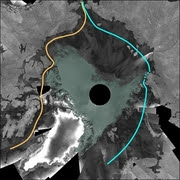
PARIS (AFP) - The Northwest Passage, the dreamed-of yet historically impassable maritime shortcut between Europe and Asia, has now fully opened up due to record shrinkage of Arctic sea ice, the European Space Agency (ESA) said on Friday. It released a mosaic of images, taken in early September by a radar aboard its Envisat satellite, which showed that ice retreat in the Arctic had reached record levels since satellite monitoring began in 1978. "We have seen the ice-covered area drop to just around three million square kilometres (1.158 million square miles), which is about one million square kilometres (386,000 sq. miles) less than the previous minima of 2005 and 2006," said Leif Toudal Pedersen of the Danish National Space Centre. "There has been a reduction of the ice cover over the last 10 years of about 100 000 sq. km. (38,600 sq. miles) per year on average, so a drop of one million sq. km. (386,000 sq. miles) in just one year is extreme." More...

New Jersey Sets National Precedent by Passing the Global Warming Response Act

TRENTON - On the final day of votes before their summer break, the New Jersey Legislature overwhelmingly passed the Global Warming Response Act, A3301/S2114, (72-8 in the Assembly, 36-1 in the Senate). This ground-breaking legislation requires a mandatory reduction of the state’s global warming pollution to below 1990 levels by 2020 and 80 percent below current levels by 2050. These are the limits scientists say are necessary to avoid the worst impacts of global warming. "Global warming is the most urgent environmental issue in our lifetime,” said Senator Buono, D-Middlesex. “This legislation sets up a comprehensive solution to global warming. It will reduce our dependence on foreign oil and increase energy efficiency, resulting in significant cost savings for both families and businesses.” More...

Icequakes in Greenland Put on Pace

Image
Vlad Tarko, Senior Editor, Sci-Tech News The icequakes in Greenland are caused by the motion of the glaciers and are most common in July and August when temperature is higher. But the seismologists from Columbia and Harvard have found that the total number of such "glacial earthquakes" have more than doubled since 2002. More....

UN Calls for Pedal Power to Reduce Environmental Damage

Image
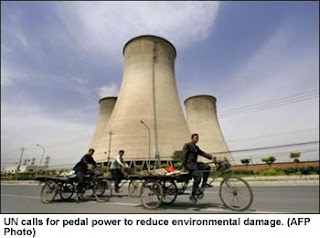
Agency France Presse, posted on Commondreams KUALA LUMPUR - More bicycle riding and other lifestyle changes are urgently needed to reduce climate-altering carbon emissions that are damaging Asia’s health and could also threaten the economy, the World Health Organisation said Monday. Climate change contributes directly or indirectly to about 77,000 deaths per year in the region, according to WHO estimates. “So far the impact is on the health of the people. If the trend continues, it may have an impact on the economy,” said Shigeru Omi, WHO’s regional director for the Western Pacific. “Of course the threat is there. We should not wait for that to happen,” he told reporters at the start of a four-day conference on the impact of climate change and health in Southeast and East Asian countries. Omi said urgent action was needed because Asia’s share of the world’s greenhouse gas emissions was expected to grow larger with the rapid economic expansion of China and India. “We have now reached a...

As Glaciers Melt and Rivers Dry Up, Coal-Fired Power Stations Multiply

Image
by Jonathan Watts / John Vidal, The Guardian UK BEIJING - On a bad day - which can be hundreds in a year - the ancient city of Linfen in the northern province of Shanxi is environmental hell. Named by the World Bank last year as having the worst air quality on Earth, its 3.5 million people more often than not choke on coal dust; its soil and its rivers are covered with soot, and its Buddhas are blackened and shrouded in a toxic mist. The cause is Linfen’s 196 iron foundries, its 153 coking plants, its unregulated coalmines, tar factories, steelworks and domestic homes, all of which burn cheap, easily accessible brown coal. Shanxi is the centre of China’s vast and growing coal industry, which was pinpointed yesterday by Dutch government scientists as the major culprit, along with the cement industry, in the country’s sudden surge to the top of the world’s league of greenhouse gas emitters. In the last six years, the Chinese coal industry, with reserves put at more than 1 trillion tonnes...

Democrats Press Plan to Channel Billions in Oil Subsidies to Renewable Fuels

Image
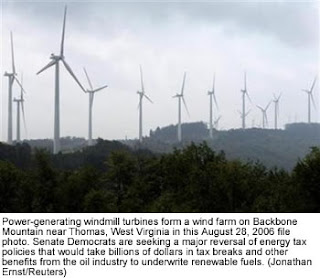
by Edmund L. Andrews, NY Times, Posted on Commondreams WASHINGTON - Senate Democrats are seeking a major reversal of energy tax policies that would take billions of dollars in tax breaks and other benefits from the oil industry to underwrite renewable fuels. The tax increases would reverse incentives passed as recently as three years ago to increase domestic exploration and production of oil and gas. The change reflects a shift from the Republican focus on expanding oil production to the Democratic concern about reducing global warming. More....